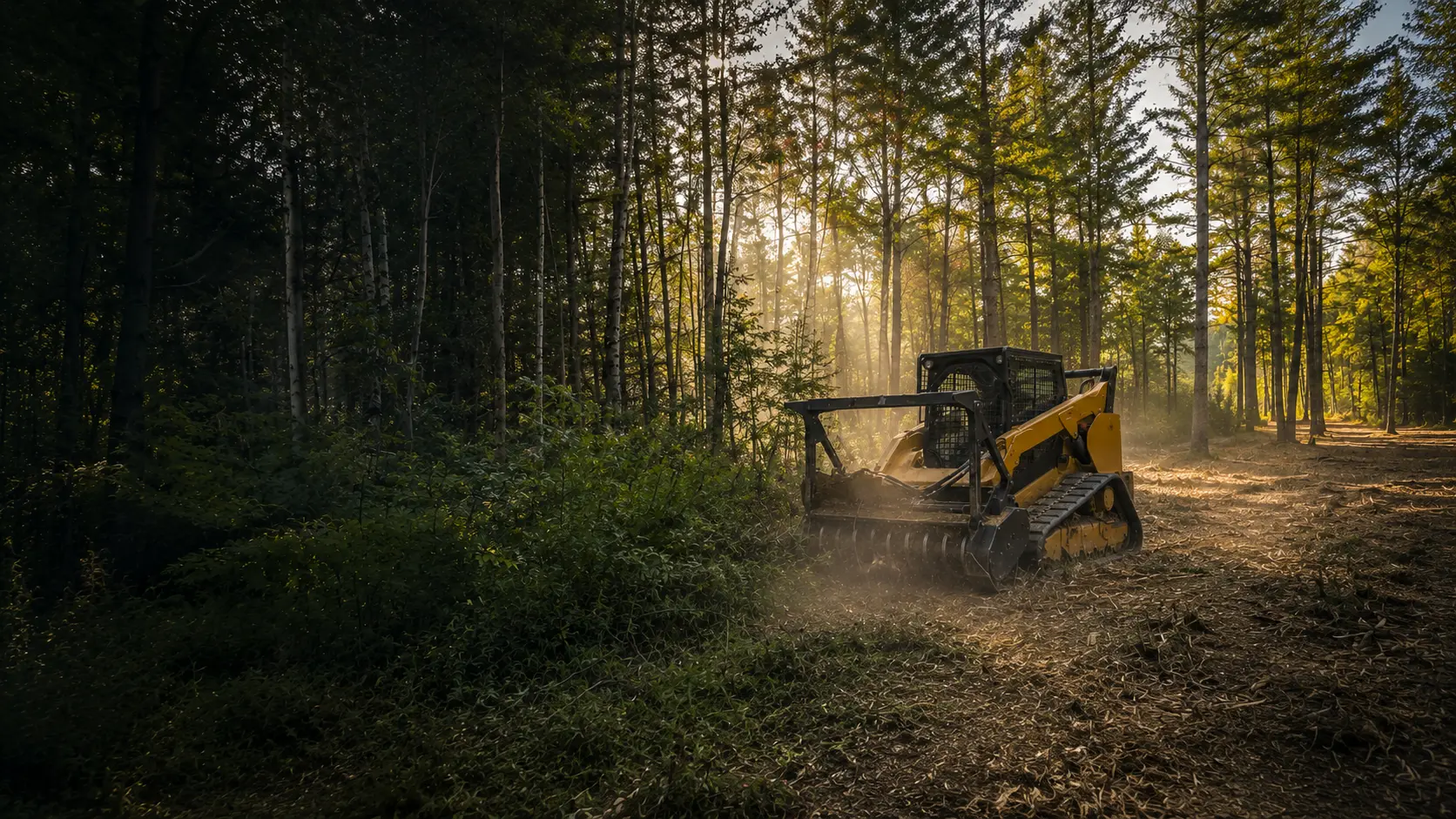
Japanese knotweed is widespread and severely invasive in Maine. Originally introduced as an ornamental in the late 1800s, it has spread throughout Southern Maine's riverbanks, roadsides, and residential properties. Mechanical treatment can quickly reduce above-ground biomass and improve access, but it does not remove the full underground rhizome system by itself. Effective management usually requires containment, repeated treatment, monitoring, and a plan matched to the patch and site. Regrowth should be expected. This guide explains how to identify knotweed and how to plan realistic control.
How to Identify Japanese Knotweed in Maine
Japanese knotweed (Fallopia japonica) is often mistaken for bamboo because of its hollow, segmented stems. Here is how to positively identify it on your property:
Key Identification Features
- Stems: Hollow, bamboo-like, green with reddish-purple speckles. Grow up to 10 feet tall in a single season. Dead stalks persist through winter as brown-red canes.
- Leaves: Heart-shaped (or shield-shaped), approximately 6 inches long with pointed tips. Arranged alternately on the stem in a distinctive zig-zag pattern.
- Flowers: Small, creamy-white clusters appear in late August through September along the upper stems.
- Root system: Established plants form an extensive underground rhizome network that spreads well beyond the visible stems, and even small viable fragments can produce new plants.
- Growth rate: Can grow up to 4 inches per day during peak season (May through July).
Knotweed is commonly found along the Saco River, Presumpscot River, and throughout Portland, Scarborough, Biddeford, and Westbrook. It thrives in disturbed areas, riverbanks, roadsides, and the edges of residential properties. If you see dense stands of bamboo-like plants anywhere in Southern Maine, it is almost certainly Japanese knotweed.
Why Japanese Knotweed Is a Serious Problem
Knotweed is not just an aesthetic nuisance. It causes real, measurable damage to properties and ecosystems across Southern Maine:
Property Damage
Knotweed rhizomes exploit existing cracks and weaknesses in foundations, retaining walls, drainage lines, septic components, and asphalt, and growth can widen them over time. It is not established that knotweed cracks sound, undamaged structures. In the UK, lenders have treated knotweed as a mortgage concern, and home inspectors in the Northeast increasingly note it during pre-sale inspections. Effects on any individual sale or appraisal vary by property and market, so we do not promise a specific value impact.
Ecological Damage
Knotweed forms dense monocultures that shade out all native plants. Along riverbanks, it displaces native vegetation that stabilizes soil, leading to increased erosion and degraded water quality. It provides almost no food value for native wildlife. Once established, it dominates the landscape and eliminates biodiversity.
Spread Mechanism
Knotweed spreads primarily through its rhizome network, but living stem nodes and rhizome fragments can also produce new plants. Improper cutting, mowing, disposal, or composting can spread it to new areas, and moving soil that contains rhizome fragments is one of the most common ways it colonizes new properties in Southern Maine. Any mechanical work therefore carries a spread risk if plant material, soil, or contaminated equipment is moved.
Why DIY Knotweed Removal Fails
Most homeowners try cutting, mowing, or pulling knotweed before calling a professional. Here is why these methods fail:
Cutting or mowing removes above-ground growth but does nothing to the underground rhizome network. The plant simply regrows from stored energy in the roots. Worse, cut stem fragments can root in new locations, spreading the infestation. You can mow knotweed every week for years and it will keep coming back.
Pulling by hand is rarely practical for an established stand. The rhizome network is extensive and difficult to reach or remove completely, and incomplete removal can leave viable fragments in the soil that produce new growth.
Herbicide is a separate decision from mechanical work. Taylor Forestry Mulching provides mechanical service and does not apply herbicide. The Maine DACF notes that herbicide can be effective as part of some knotweed plans. If it is appropriate for a site, it should be evaluated and applied by a properly licensed professional under label directions and applicable Maine requirements. Applications near water or within regulated areas are subject to additional state rules.
How Mechanical Treatment Fits a Knotweed Plan
Mechanical mulching quickly reduces above-ground biomass and improves access. Our equipment cuts dense stands into mulch far faster than hand-cutting or mowing. One visit addresses visible top growth, not the underground rhizome system.
There is no reliable fixed visit count. Established stands may require management over multiple growing seasons, and Maine DACF says follow-up is needed in almost all circumstances. Regrowth should be expected, and the treated area should be monitored during subsequent seasons with follow-up based on the amount and location of new growth. Finely processed material should not be assumed to be nonviable, and processing in place does not create zero fragment-spread risk.
A responsible site plan should address the treatment boundary, material handling, equipment inspection and cleaning, neighboring infestations, proximity to water, and observed regrowth. Do not casually move or compost knotweed plant parts or soil that may contain rhizomes; local transfer-station rules may apply.
When to Treat Knotweed in Maine
Timing depends on the method and the site rather than a single ideal window. Maine DACF describes repeated cutting throughout the growing season as an approach for small patches, while larger, established stands require an integrated plan with follow-up over multiple seasons. Mechanical treatment can be scheduled whenever access and site conditions allow, and we plan repeat visits around observed regrowth. If foliar herbicide is part of a plan, timing is determined by the licensed applicator under label directions, with flowering and pollinator precautions taken into account.
If you are selling your home, start as early as possible. Repeated treatment produces the best visual results, and a documented treatment and monitoring history can help buyers and inspectors understand the plan in place.
Japanese Knotweed Questions We Hear Most
Does forestry mulching eliminate Japanese knotweed in one visit?
No. One visit can reduce above-ground biomass and improve access, but it does not eliminate the underground rhizome system. Maine DACF says follow-up is needed in almost all circumstances, and established stands may require management over multiple growing seasons.
Can mechanical treatment spread Japanese knotweed?
Live stem nodes and rhizome fragments can produce new growth, so mechanical work carries a spread risk if plant material, soil, or contaminated equipment is moved. A responsible plan includes containment, appropriate material handling, and equipment inspection and cleaning. We do not promise zero spread risk.
How many treatments will my property need?
There is no reliable fixed number. Patch size, site conditions, proximity to water, neighboring infestations, treatment method, and regrowth all affect the timeline. Established stands commonly require a multi-year plan.
Will Japanese knotweed grow back after mulching?
Regrowth should be expected because mechanical treatment does not remove the full rhizome system. The treated area should be monitored during subsequent growing seasons, with follow-up based on the amount and location of new growth.
What happens to cut knotweed material?
Knotweed plant material should not be composted or casually moved. Handling depends on the site and treatment method. Soil containing rhizomes requires special care, and local transfer-station rules may apply.
Do you use herbicide?
Taylor Forestry Mulching provides mechanical treatment and does not apply herbicide. Maine DACF says herbicide can be effective in some knotweed plans. If it is appropriate for a site, it should be evaluated and applied by a properly licensed professional in accordance with label directions and applicable Maine requirements.
Have Knotweed on Your Property?
Call (207) 819-8660 for a free on-site assessment. We will identify the species, assess the extent of the infestation, explain the containment and follow-up your site is likely to need, and give you an honest quote. Serving Portland, Scarborough, Biddeford, Saco, and all of Southern Maine.