If you have Japanese barberry growing on your property in Southern Maine, you have a Lyme disease problem. Research from the Connecticut Agricultural Experiment Station and Maine Medical Center's Lyme and Vector-Borne Disease Laboratory has established a direct connection between Japanese barberry thickets and dramatically elevated populations of Lyme disease-carrying blacklegged ticks. Removing barberry is one of the most effective things you can do to protect your family from tick-borne illness.
The Science: Why Barberry Creates Perfect Tick Habitat
Japanese barberry (Berberis thunbergii) creates a unique microclimate beneath its dense, thorny canopy. The thick branching structure traps humidity at ground level, creating the moist conditions that blacklegged deer ticks need to survive. Studies have documented that barberry patches can harbor up to 12 times more Lyme disease-carrying ticks per acre compared to areas without barberry.
The connection goes deeper than just humidity. White-footed mice, which are the primary reservoir host for the Lyme disease bacterium (Borrelia burgdorferi), nest inside barberry thickets because the thorns protect them from predators like foxes, hawks, and owls. These mice carry the Lyme bacterium and pass it to tick larvae that feed on them. The result is a concentrated cycle of Lyme disease transmission happening right in your backyard.
Key Research Findings
- Barberry patches harbor up to 12 times more infected ticks per acre than areas without barberry
- Removing barberry from forest areas reduced tick abundance to near-zero levels within three years (Connecticut Agricultural Experiment Station)
- White-footed mice density is significantly higher in barberry-infested areas
- The humid microclimate under barberry extends tick activity season by several weeks
- Maine has banned the sale of Japanese barberry since January 1, 2018 (Maine DACF Do Not Sell Plant List)
How to Identify Japanese Barberry
Japanese barberry is a dense, thorny shrub that grows 3 to 5 feet tall with arching branches. It is extremely common throughout Southern Maine, found in woodland edges, abandoned fields, residential property boundaries, and along trails in Gorham, Windham, Standish, Buxton, and throughout York and Cumberland counties.
Identification Features
- Leaves: Small, oval, smooth-edged. Green varieties and red/purple cultivated varieties both exist. Leaves turn brilliant red in fall.
- Thorns: Single sharp thorns at each leaf node along the stems. Shorter than multiflora rose thorns but still painful.
- Berries: Bright red, oblong berries that persist through winter. Spread by birds to new locations.
- Growth habit: Dense, mounding shrub with arching branches that form impenetrable thickets.
- Inner bark: Bright yellow when scraped, a distinctive identification feature.
Why Manual Barberry Removal Is Dangerous
Attempting to remove barberry by hand puts you directly in the highest-risk tick habitat on your property. You are wading through dense thorny thickets where infected ticks are concentrated at their highest density. The thorns tear clothing and create skin exposure. Every minute spent hand-pulling barberry is a minute of maximum tick exposure.
Beyond the tick risk, barberry is physically difficult to remove by hand. The root systems are extensive and woody. Pulling individual plants is exhausting work, and any root fragments left behind will regenerate. A mature barberry thicket covering even a small area can take days of manual labor to clear.
How Our Remote-Controlled Mulcher Solves the Problem
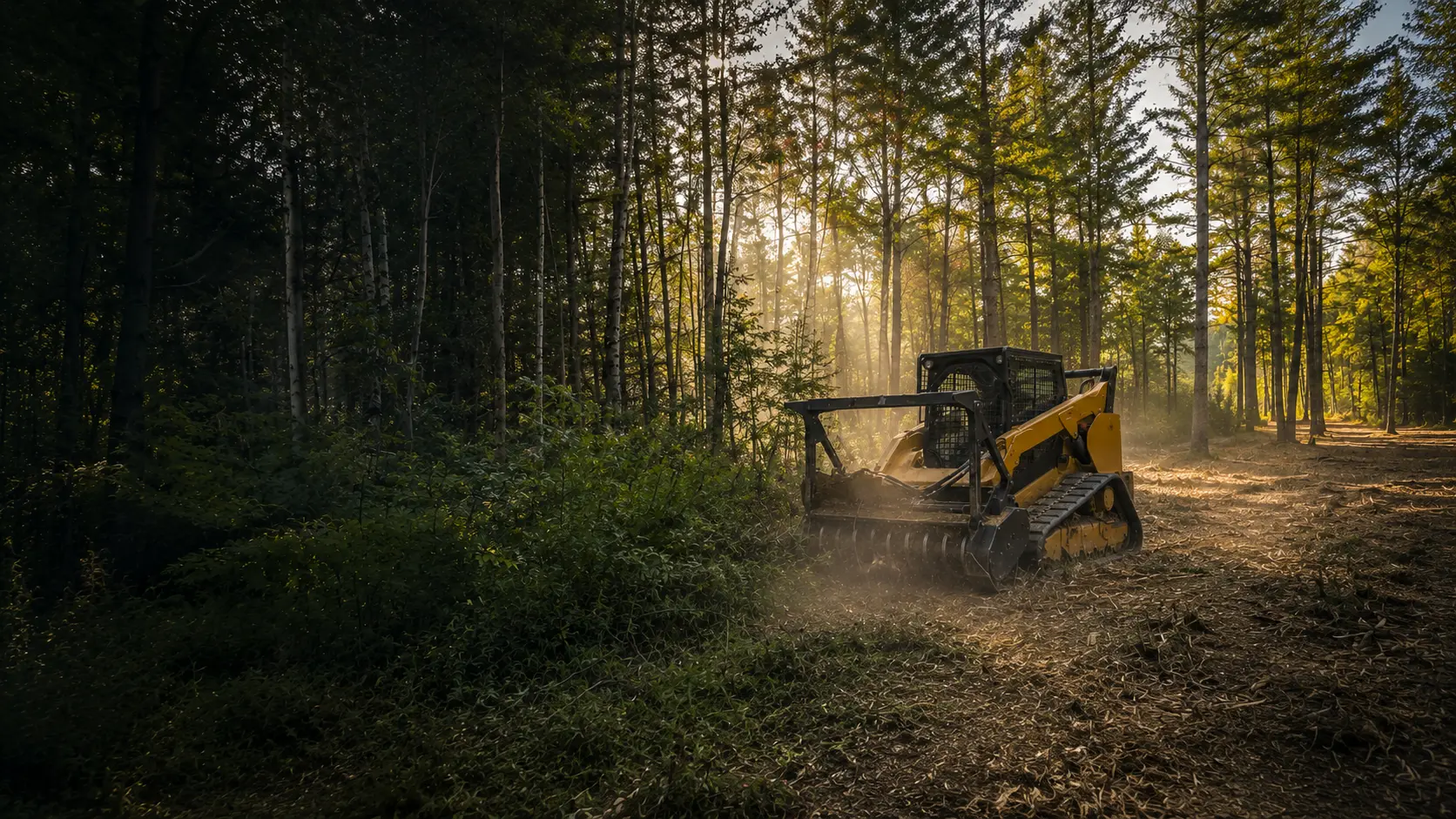
Our remote-controlled mulcher is the ideal tool for barberry removal. The operator stays at a safe distance, completely outside the tick-infested thicket, while the machine grinds the barberry down to ground level. No human contact with the plants. No wading through tick habitat. No torn clothing creating skin exposure.
The mulching head processes the entire shrub, thorns and all, into fine mulch that stays on the ground as a suppression layer. A barberry thicket that would take a crew days to clear by hand is processed in hours. The ground-level mulch blocks sunlight from reaching any remaining root crowns, suppressing regrowth.
Research from the Connecticut Agricultural Experiment Station found that clearing barberry from forest areas reduced tick abundance to near-zero levels within three years. Clearing barberry reduces the humid microclimate and the protected mouse habitat that support ticks. Results vary by site, and monitoring plus follow-up treatment of regrowth is normally part of the plan.
Protecting Your Family from Lyme Disease
Maine consistently ranks among the top five states for Lyme disease incidence. York and Cumberland counties, which make up most of Southern Maine, report hundreds of confirmed cases annually. Removing barberry from your property is one of the most impactful steps you can take to reduce your family's exposure to infected ticks.
If you have barberry on your property in Gorham, Windham, Standish, Buxton, Hollis, or anywhere in Southern Maine, call (207) 819-8660 for a free assessment. We will identify the extent of the infestation and give you an honest quote. Your family's health is worth more than a thorny shrub.
Reduce Lyme Disease Risk on Your Property
Call (207) 819-8660 for a free barberry assessment. Our remote-controlled mulcher removes barberry thickets without anyone entering the tick-infested area.